
Affiliate disclosure: As an Amazon Associate I earn from qualifying purchases. Learn more
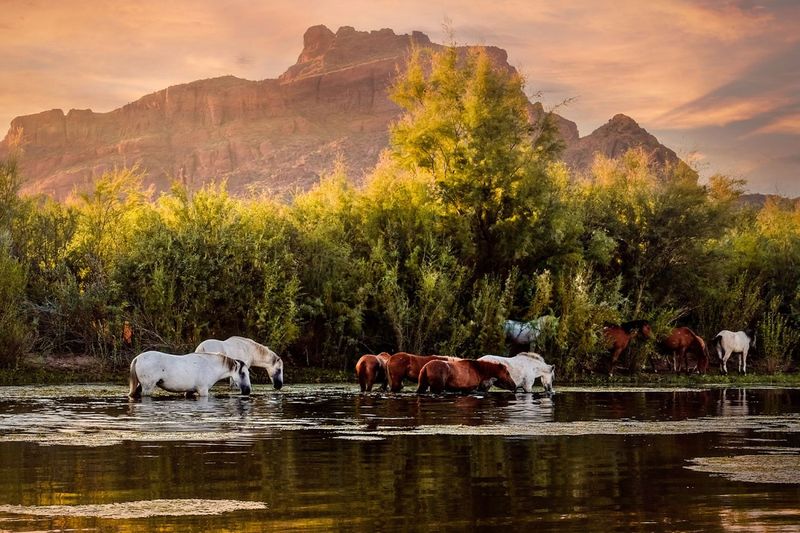
Only a short trip from the Phoenix and Mesa suburbs, a herd of horses lives along the Lower Salt River. They graze near cottonwoods, wade into the water, and sometimes stop traffic on river roads.
Locals have a deep attachment to them, and the horses come with their own set of rules, protections, and debates. Here is what you need to know before you go looking.
The Lower Salt River brings a possible horse encounter near Phoenix
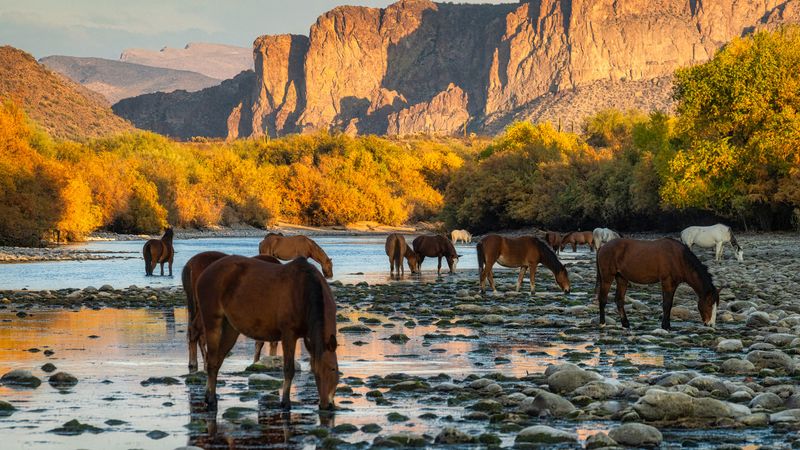
Picture a ribbon of green cutting through the Sonoran Desert, just beyond the last stretch of Mesa neighborhoods. That is the Lower Salt River, and it is home to one of Arizona’s most photographed surprises.
Free-roaming horses live along the river and around Saguaro Lake in the Tonto National Forest, as described in a Forest Service FAQ on the Salt River horses.
For Valley locals, the appeal is how quickly the scene changes. You leave strip malls and freeway ramps behind, and soon you are looking at horses standing in the shade of riverside trees.
Visit Mesa’s horse guide shows how much the herd has become part of the area’s identity.
If you have ever driven to Oatman and smiled at burros wandering past storefronts, you already know the feeling. The comparison is only about atmosphere, the everyday charm of animals living alongside people.
The horses and the burros have different histories and are handled differently, so think of it as a shared mood and nothing more.
One thing to keep in mind is that the herd lives in a managed area, not an unlimited open range. The Forest Service’s land planning work, including the Tonto National Forest plan environmental impact statement, treats the horses as part of a landscape with boundaries and responsibilities.
No outing guarantees a sighting, but the chance alone makes the river worth a morning of your time.
What “wild” means for the Salt River herd
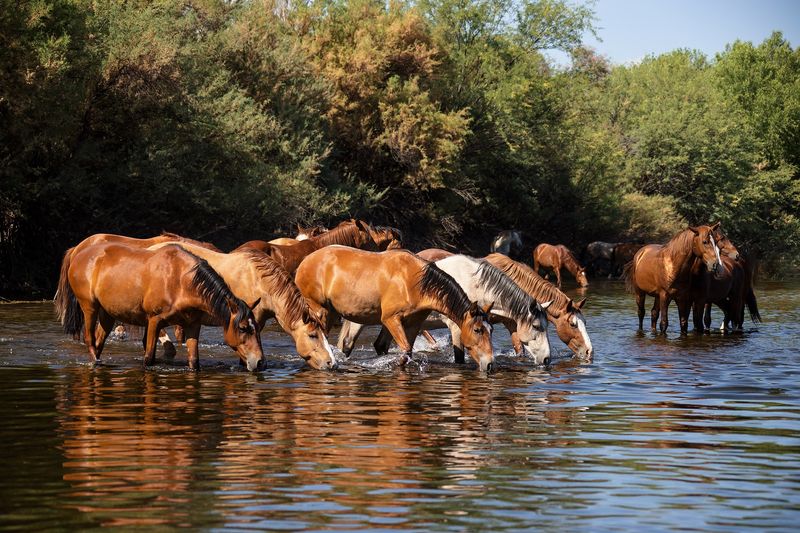
Call them wild if you like, as long as you mean free-roaming in the everyday sense. It does not mean unprotected, and it does not mean unmanaged.
The horses live under a specific set of rules written by the state of Arizona.
Under Arizona Revised Statutes section 3-1491, the protected Salt River herd is made up of unbranded or unmarked horses that inhabit, and have historically lived in, the Lower Salt River and Saguaro Lake area. The law bars harassing, injuring, killing, chasing, capturing, or interfering with these horses.
There are exceptions for authorized actions, so the rule is not absolute in every circumstance.
The statute also says the horses are not stray animals under Arizona’s stray-livestock laws. In practical terms, that keeps them from being handled like a loose cow or a runaway pony that anyone can round up.
Federal law is a different matter. The Forest Service explains in its FAQ that the Salt River herd is not designated under the federal Wild and Free-Roaming Horses and Burros Act.
Their protection comes from Arizona law instead.
That is also why the Oatman comparison stops at atmosphere. Whatever rules cover burros in a mountain town, they do not set the legal standing of these horses.
And as the Tonto National Forest plan documents show, the herd lives within a bounded, managed area.
The herd’s origins remain contested
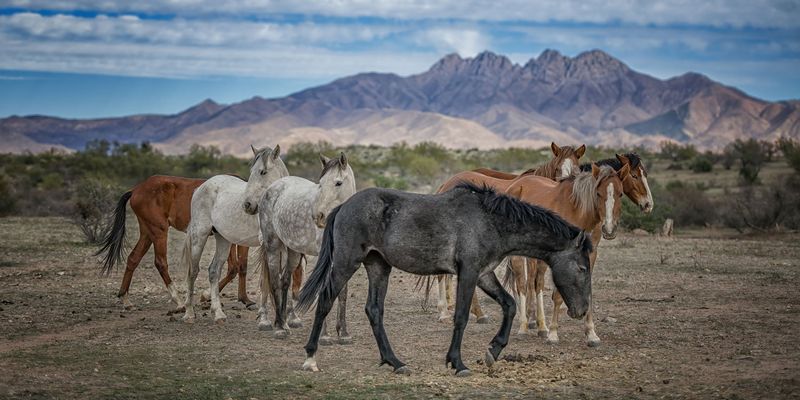
Ask five people where the Salt River horses came from and you may hear five stories. The truth is that the herd’s origin is disputed, and it has not been settled.
The Forest Service gives one account in its FAQ. It says it found no historical documentation establishing the proposed ancient lineage.
In its view, the current herd descends from livestock that strayed onto federal land.
Advocates see it differently. Many have argued that the horses have an older, Spanish-influenced history in the region.
One example is a community-submitted account, History of the Salt River Wild Horses, published through the Salt River Pima-Maricopa Indian Community.
Popular tales about Father Kino or centuries in the same spot are often repeated, but they should not be treated as proven. Both sides have passionate supporters, and neither claim has been confirmed by testing.
Science may eventually add to the conversation. In August 2026, the Governor’s Office announced a genetic viability study for the herd.
The study has only been announced, so no one can say yet what it will show. Until results arrive, the fair way to talk about where these horses came from is to say that people disagree.
Management is shaping the herd’s future
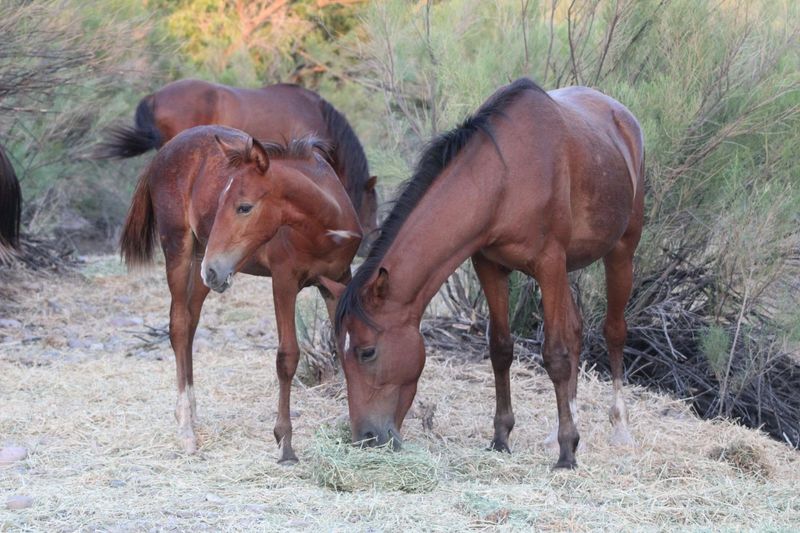
Behind every peaceful river photo is an active management effort. The herd ranges within a managed area, and the people responsible for it make real decisions about its size and care.
The Forest Service’s land plan, laid out in the Tonto National Forest environmental impact statement, recognizes the herd as part of that managed landscape.
In February 2026, the Arizona Department of Agriculture announced a herd management contract. It covers fertility control, natural attrition, and relocation to approved sanctuaries.
Those are the tools the state described for guiding the herd over time.
A separate announcement followed on August 31, 2026. The Governor’s Office said it was funding a genetic viability study, with the Arizona Board of Regents involved.
It also said the Department of Agriculture had paused removals under the current plan for 2026 and 2027 while the research moves forward.
Keep those two moments apart in your mind. The February contract described the management tools, and the August announcement added the study and the pause on removals.
The pause covers a specific period and is not a permanent promise.
The study is also not finished, so it has not answered questions about the herd’s ancestry. For locals who care about the horses, the practical step is to follow state announcements as the plan develops over the next couple of years.
Coon Bluff is a place to start looking, not a sure thing
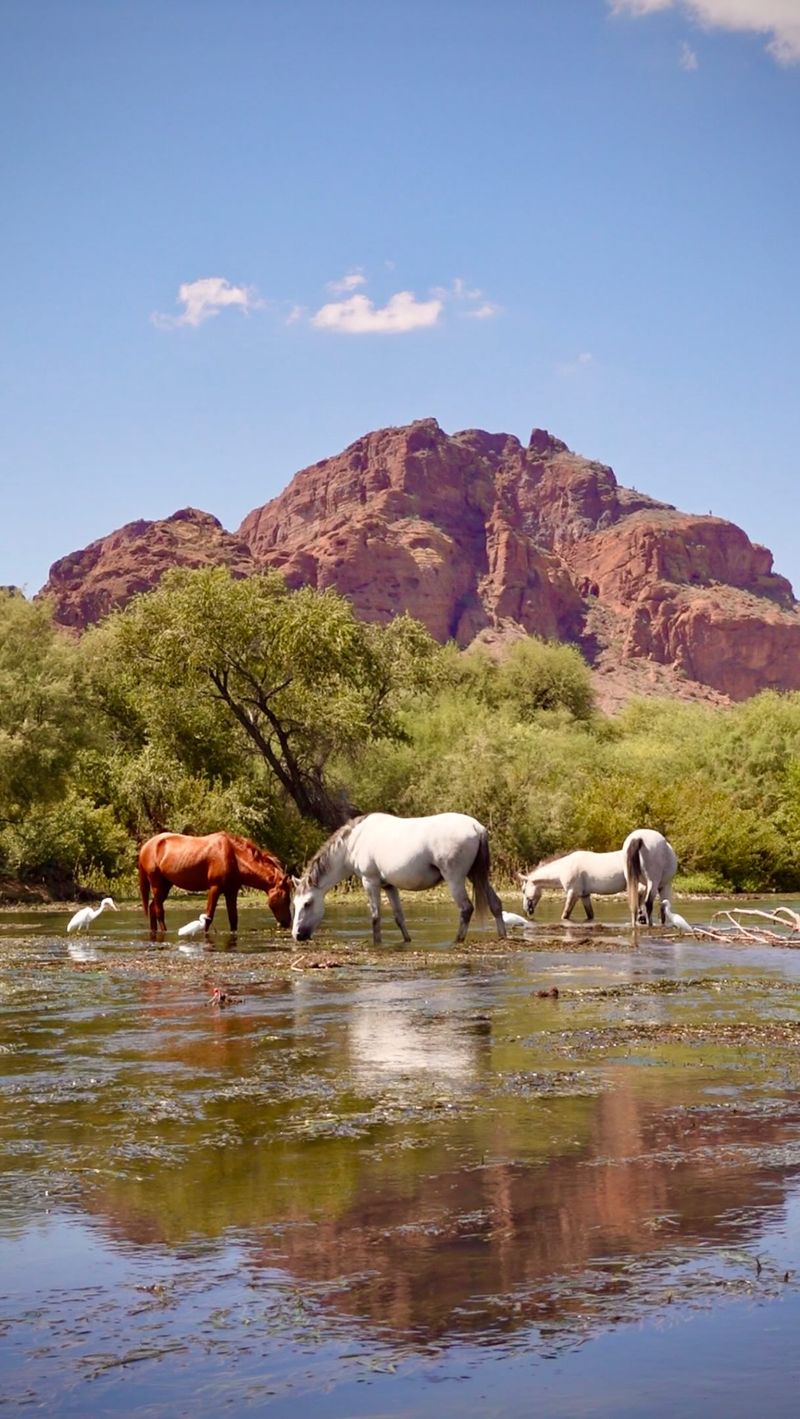
Plenty of locals begin at Coon Bluff. Visit Mesa’s Coon Bluff guide lists it as a place to hike, fish, and watch for horses along the Salt River.
That makes it a sensible first stop, though not a promise.
Other river recreation areas are worth exploring as well. Granite Reef, Phon D Sutton, Water Users, Goldfield, and Pebble Beach are all named sites along the Lower Salt River, and Visit Mesa’s wider horse guide can help you plan a route.
None of them is a guaranteed horse spot.
Horses move. A herd that lingered at one bend last weekend may be somewhere else entirely today.
Some outings end with a dozen horses in view, and others end with only a pleasant walk and a good look at the river.
A relaxed attitude helps. Bring binoculars, a camera with a zoom lens, water, and patience, and treat any horse you see as a bonus.
Scan the shoreline and grassy flats rather than expecting animals to be waiting in one place.
Before you leave home, check the Tonto National Forest recreation page for current site conditions and closures. Conditions along the river can change, and a quick look can save you a wasted drive.
Give the horses room along the river
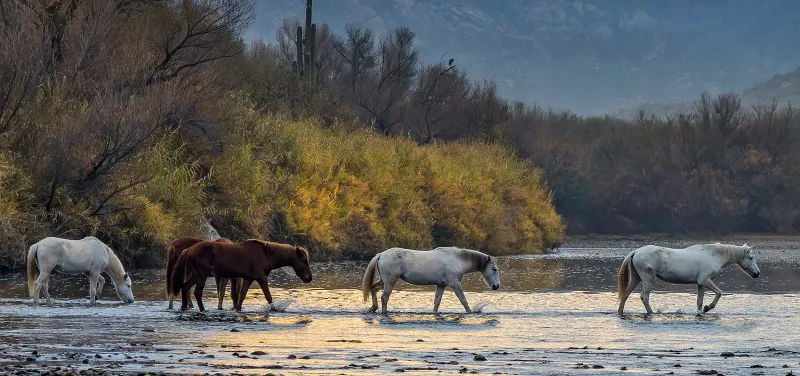
When you do spot a horse, the best move is to slow down and keep your distance. The Salt River Wild Horse Management Group recommends staying at least 50 feet back, as noted on its page about watching out for the herd.
That is safety advice from the group, not a distance written into state law.
The law does matter, though. Arizona’s statute on the herd prohibits harassing, chasing, capturing, or otherwise interfering with the horses, with exceptions for authorized actions.
A good photo is never worth crossing that line.
Do not feed or touch the horses, and do not chase or harass them. Never stand between a horse and the water, and never block its path to a drink, especially on a hot day.
A zoom lens gives you the close-up without any of the risk.
Keep dogs on a leash, since a loose dog can startle a horse or start a bad encounter. Pack out every bit of trash too, because snack wrappers and bottles do not belong on a river that wildlife depends on.
Finally, check Forest Service conditions and closures before you head out. The horses were here first on any given morning, so let them keep the river the way they found it.